



This sunday, I volunteered to create paper origami cranes as a message to bring hope and peace into the world at the Grace Cathedral.
If there is one message that is right for this week as we approach thanksgiving, it’s to be grateful to have our dear ones with us. To instil hope and peace in the world we live in and bring harmony in everything we do.
We lost another beautiful kind and fearless soul last month and I attended her celebration of life. RIP Monica! We miss you and I am grateful to have had the chance to work with you in this lifetime.
Grace Cathedral, San Francisco is decorating a 15ft tree with 10k origami cranes.
Do you have a wish for the world?
Give your wish wings and help decorate the Rainbow World Fund World Tree of Hope ®.
worldtreeofhope.org
Send your wishes of hope and peace through DecemberThis December, thousands of origami cranes inscribed with wishes for the future of the world will decorate the 19th annual Rainbow World Fund (RWF) World Tree of Hope at Grace Cathedral in San Francisco, CA.
Help us decorate the tree from November 2 to Dec. 1 at Grace Cathedral in San Francisco, sign up via this Google Form link: https://bit.ly/WorldTreeofHope-Volunteer-2024
So, let’s now talk about messaging in the world of product marketing.
What’s in it for me?
Messaging and positioning are at the core of reaching the right audience at the right time and in the right place. Storytelling reaches far and wide where features and functionality don’t.
Every product marketing manager (PMM) is keen on telling the best award-winning story about their customers. You know the good and bad ones when you hear them.
Positioning and Messaging: Heart and Soul of Product Marketing

Have you ever wondered what makes a good positioning and messaging?
B2B SaaS Messaging
In the world of software as a service (SaaS), customer lifetime value is critical for long-term success. We are players in an infinite game, as Simon Sinek shared. We need to define the right metrics to make sure we reach a win-win approach with people, technology and innovation in mind.
We all know we need to put the customer first, as the customer has all the power. At the start of every customer journey is the buying cycle. Our B2B customer’s needs often vary based on urgency and timing.
Step 1: Find the true buyer persona.
We want to find our product-market fit, and that starts with the buyer journey. As a SaaS platform, it’s easy to say we can solve for any use case, but it doesn’t help drive scale. Our first step is to identify our true buyer personas so we can position our value proposition to customer pain points.
Business Initiative Leads: agents of change or champions
Practitioners/Influencers: users
Executive Signoffs: economic buyers and decision-makers
Step 2: Identify the right market segment.
Even B2B buyers are looking for personal value from a technology investment. We need to help them grow in their careers and showcase the right investments as strategic decisions. With our short attention span in this digital era, it is critical to build awareness and an emotional connection between the product/technology and the customer, at the right time and at the right place. This requires taking two factors into consideration:
Market Segment: Focus on the right segment as the company evolves. Solve customer needs across segments (enterprise, midmarket).
Industry: Our customers exist across industries, but over time, a few industries and use cases show the true value and differentiator in that vertical.
Step 3: Establish key metrics to measure success.
Keep the customer and their goals in mind across product, sales and marketing efforts to drive cross-functional alignment. With objectives and key results (OKRs), we can build transparency and visibility across the organization to drive focused efforts. Based on customer need, timing or urgency, OKRs can help ensure there is a pervasive need versus a niche use case for the loudest customer voice.
Step 4: Map the customer journey.
We need to map out the entire customer journey, from awareness to consideration to decision to adoption to retention. It’s easy to stay focused on only the buyer journey within sales and marketing, but the reality is that our influencers in the buyer personas can be user champions leading the change inside their organization.
From Messaging to Narrative
With a strong and cohesive story arc and narrative, we can shift the story from what is to what could be and paint the future vision for our customer’s success.
Whether you are in a crowded marketplace or a unique niche segment, find your voice and create the advocacy champions that will champion your story.

Here are 2 examples of messaging and positioning that translated into our visual narrative in action. This is our story that matters and connects with our customers.
B2B SaaS Unified Platform

Services Lifecycle

Messaging, November 26
12 pm EST | 9 am PST | 5 pm BST
Messaging is about WAY more than just reeling off a bunch of awesome features and benefits. It’s about the internal and external perception of your product, strategic guidance for sales and marketing, and laying the foundation for lucrative lead conversion through cohesive content and communication.
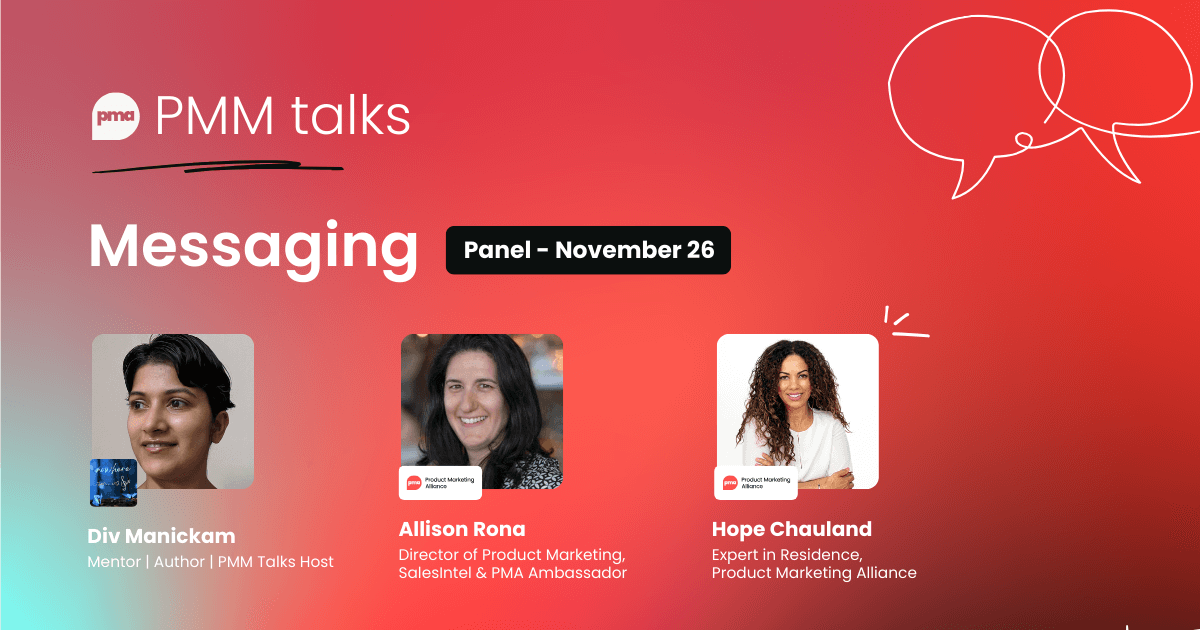
Join the upcoming PMM Talks panel on "Messaging" to find out more.
Q1. The million $ question: why do our customers choose us over the competition? How do you approach this today by understanding the market, customer, competition?
Q2. What does good Positioning and Messaging look like?
Q3. What does bad Positioning and Messaging look like?
Q4. Could you share best practices on setting Timeline and Expectations when you embark on a positioning and messaging refresh?
Q5. As product marketing, how can we connect the dots between narrative, storytelling and buyer journey?
Q6. 2024 & The Future
What do you think the future holds for positioning and messaging in the world of AI? How do we as product marketing adapt to the new world?